



This is what Los Angeles Rams general manager Les Snead had warned about.
During the offseason, he’d heard the chorus of predictions about the Rams putting together a “super team” lined with multiple future Hall of Famers. Forecasts of presumed dominance that were punctuated with the belief that adding Aaron Donald to the already star-studded cast could make the Rams virtually unbeatable.
By training camp, it had Snead swatting away grandiose assessments. Including one I made when we spoke in July.
“This would be the best roster you’ve ever had,” I suggested. “It would be the most talented, right?”
“Until you prove it, it’s all just a flip-card,” Snead said, referencing game-day depth charts distributed to the media. “You can have whatever debate, but unless you go out there and get results, it’s just a flip-card.”
I clucked my tongue with some skepticism. Of course this roster was going to get results. Surely he’s slow-playing expectations, I thought.
Then came Thursday’s game against the San Francisco 49ers. When suddenly it was hard to not think about Snead’s point. You can have all the talent in the world, but results are the difference between a flip-card and a great team. And one week into the season, the Rams are still just a flip-card loaded with talented names.
That was the thought that resonated after seeing L.A. get whomped 27-7 by the 49ers in the league’s first international game in Australia. A matchup that became as much about the different styles of overseas travel between the franchises as the quality of the football that was produced in its wake. The 49ers arrived a week early to acclimate to a 16-hour flight spanning 8,000 miles and producing a dramatic change in time zones. The Rams made a similar trek less than 48 hours before kickoff.
The travel approaches were dramatically different. When the football was finally over, so were the results. Much to the dismay of the Rams, who went in as a predicted super team and came back out looking super flat.
Edge rusher and reigning defensive player of the year Myles Garrett had been stymied and looked gassed. Quarterback Matthew Stafford, the league’s 2025 MVP, appeared frustrated. And the mastermind head coach, Sean McVay, was simply blunt.
“Sometimes sports can humble you,” McVay said after the loss. “And today was one of those days.”
Few had this kind of debut in mind for the Rams: rocked by an injury-bugged 49ers team … ineffective on defense … anemic on offense … and leaving Melbourne as quickly — and winless — as they had arrived. A super team and its constellation of stars out of alignment, leaving McVay to cross the field after the defeat with distilled sourness hanging on his face.

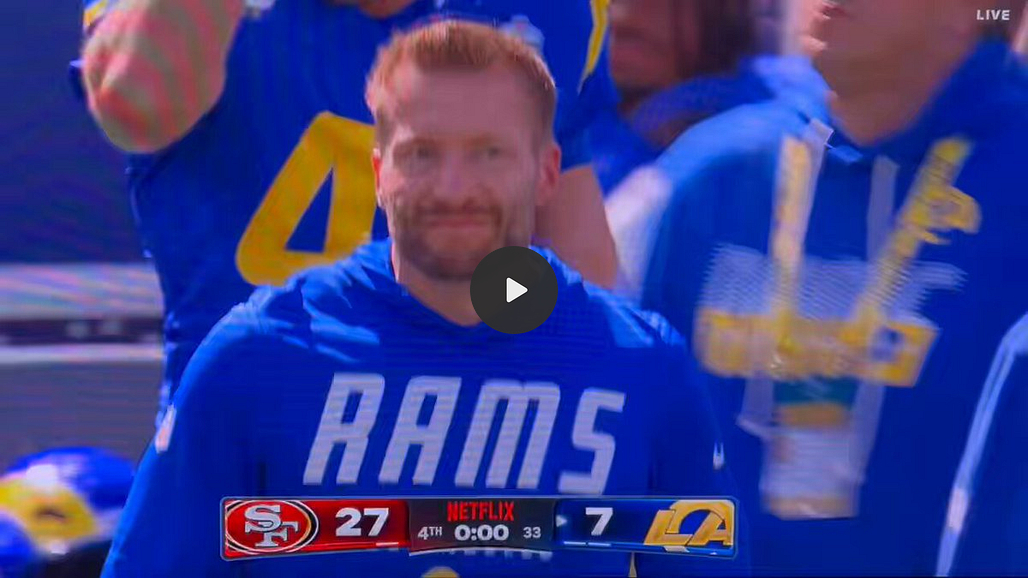
“The first thing that I’m going to look at is myself,” McVay said. “I have to do a better job for our group collectively, with our coaches, with our players. We’ll look at this film and we’ll get back to work. Because clearly that’s what we’ve got to do.”
The first priority on the agenda isn’t much of a secret, either. Not with Garrett playing a game that saw him record zero tackles and post a shocking zero pressures on 27 pass-rushing snaps. A stunning lack of output that came with an admission from Garrett that lingering knee swelling from training camp is persisting. The same knee issue that caused him to miss most of training camp.


“This was the worst version of myself that I’ve put out there,” Garrett told reporters. “I’ve got to be better. I’ve got to find a way to recover and get back to the player I know I can be and that I’ve shown that I’ve been before.”
Pressed for more specifics on the knee issue, Garrett declined to go into detail. He also declined to specify which knee was the source of the problems.
“I don’t want to get too far into that,” he said. “I wasn’t the player that I wanted to be. I didn’t feel like I was the player I’ve been before when I stepped onto that field. But I’ve got to do what I can to get back to that. … Getting healthy. That’s the main thing. When I was out there, I was a little bit more focused on myself and trying to stay healthy than what they were doing. That showed. I wasn’t who I needed to be for my team.”
That’s a sizable concern for a Rams pass rush that failed to sack Purdy in the loss. Particularly when there’s no clear timetable for Aaron Donald’s return to the field. Donald didn’t travel with the team to Australia as he continues his ramp-up process following a two-season hiatus from football.
Garrett and Donald were expected to be the frontline engine of this defense. Now one has a lingering knee injury and the other is presenting an opaque timeline for returning to active play. To put it in the parlance of Snead, these are the problems that draw a line between achieving greatness and just predicting it on a flip-card.
Granted, this was one failure, in the midst of the most brutal 72-hour travel turnaround of the season. And McVay wasn’t using that as an excuse, either.
“I don’t believe that [the travel] is why we didn’t play well enough,” he said. “… It’s easy in hindsight to be able to say it was a [mistake]. But those are responsibilities that I’ll take and then you try to be able to look at it.”
Instead, McVay pointed to communication problems on offense and defense. Stafford noted that there were too many instances of being “on different pages.” And Garrett said it was in the hands of the team leaders to get back on track.
“We knew we were going to face some adversity during the season,” Garrett said. “Come to find out, it’s game one.”
As McVay pointed out multiple times, there’s a lot of football left for the Rams. More than enough time to become everything their roster promises. But one game in, all they’ve delivered on is Snead’s warning.
The Packers looked worse. It literally looked like their era of being a consistent playoff team ended last night
Their O line got creamed in the 4th quarter in Minnesota - they were not at all prepared for what Brian FLores threw at them.
It all started with the decision to take the 3 points off the board after the Smack FG and go for it on 4th and 1. You need a better play call than the QB sneak if you are going for it and you have that inexperienced O line. That was the momentum swing that this GB was never able to recover from.
The coaching staff let the team down big time yesterday.
in my head, the rams were the monstars