


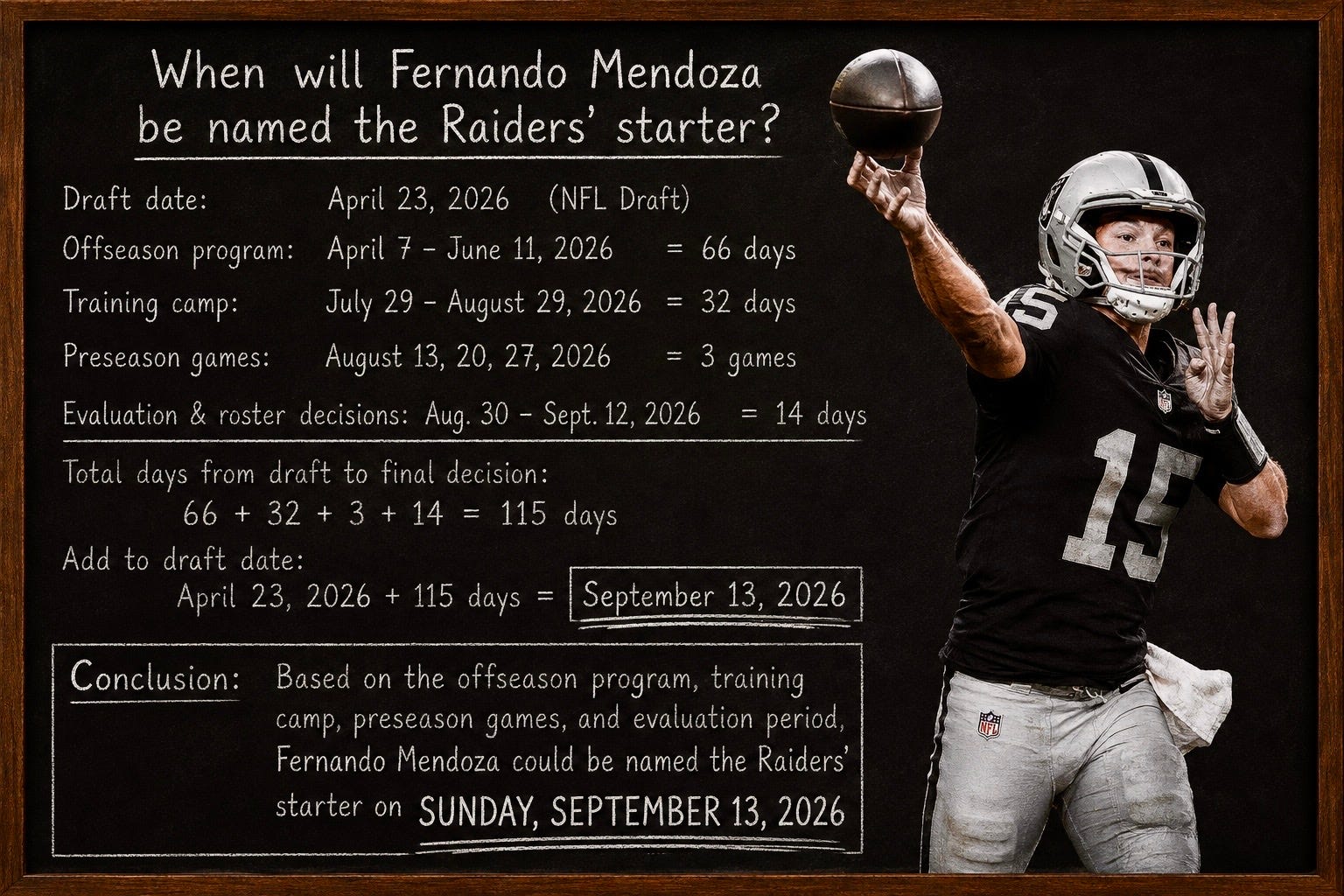
HENDERSON, Nev. — With rookie quarterbacks, it’s always about the layers of plans.
The plans to teach them how to take a snap under center. The plans to either ease them into a scheme or turn on a firehose and see how they react. The plans to sit them for a stretch or throw them into the deep end as a day-one starter. From the start for the Las Vegas Raiders, the Fernando Mendoza plan was both simple and completely driven by the player.
Push. Compete. Make an organizational decision hard.
“That’s why we took him at one,” Raiders general manager John Spytek told me when I passed through camp. “That’s who he is. That’s who we expected him to be long into the future. We just want to be mindful that we’re doing everything to win games and to take care of our young quarterback. It’s so much bigger than him being ready to play. The whole team’s got to be ready for him to be the leader of it, too.”
One game into the preseason, that effort is off to a hell of a start.
Mendoza completed 10 of 16 passes for 97 yards and a touchdown in Thursday’s 27-14 loss to the Arizona Cardinals. It was a performance that was defined as much by what was absent as by what was present. There was no interception. No moment when the speed of the game appeared to swallow him. No stretch when the operation looked too big or too fast. He wasn’t perfect, and the preseason demands that we underline the level of competition and vanilla nature of schemes. But the poise, command and accuracy that have gradually emerged in camp seemed to follow Mendoza straight into Allegiant Stadium. And that’s what truly matters right now.
Klint Kubiak has seen rookie quarterbacks look one way on a practice field and something entirely different when the game lights come on. The movement around them changes. The pocket changes. The consequences of a mistake become more dramatic. For all the work Mendoza has put into operating from under center and mastering the details of Kubiak’s system, there was no way to know how it would carry over until the Cardinals were on the other side.
What Kubiak saw looked as familiar as the Las Vegas Strip.
“I saw the same guy that we’ve seen in practice,” Kubiak told reporters afterward. “I see an ascending player.”

That’s a pretty succinct way for Kubiak to frame where this stands. But keep the economy of language in mind. Ascending doesn’t mean finished. It doesn’t mean Mendoza has taken the starting job from Kirk Cousins. Kubiak was clear after the game that it remains Cousins’ job to lose. But ascending does mean the original timeline can change. If Mendoza continues stacking practices and preseason performances, the conversation shifts from whether he can play this season to how long the Raiders can reasonably keep him off the field.
And that shift may have already begun.
Mendoza opened the offseason working with the third-team offense. When camp began, he moved up and split second-team opportunities with Aidan O’Connell. As the practices unfolded, Mendoza’s command became easier to see. He was getting in and out of the huddle. He was communicating at the line of scrimmage. He was taking snaps from under center, executing a play-action fake and then getting the ball out. Eventually, that earned him work with the first-team unit.
Again, none of this means the Raiders have ripped up their plan. Cousins opened camp as the starter because he has played good football in this league, knows the foundation of the Kubiak offense and gives Las Vegas a credible option to begin the season. The organization didn’t acquire Cousins by accident. It wanted a veteran who could steady the offense and allow Mendoza to develop without every August practice becoming a referendum.
But rookie quarterback plans are never static. They react to the player. If Mendoza struggles, the plan stretches. If he flourishes, it contracts. As it has all along.
Early in camp, I asked Spytek to spell out how Mendoza could impact his destiny. Would this end up like so many other No. 1 overall QB picks who started the season from Week 1? Would it be a Baker Mayfield transition and last a few weeks, or mirror the level of patience the then-St. Louis Rams showed with Jared Goff, sitting him all the way into November of his rookie year?
“It’s all of it,” Spytek said. “How Fernando practices, how Kirk practices, wins and losses. If Kirk’s in there and we’re 7-3 after 10 games, that’s different than if we’re 3-7. That’s probably ultimately what kept [Patrick] Mahomes on the bench [as a rookie with the Kansas City Chiefs]. They were in the playoffs. They were in the race through the whole thing.”
“Right now we’re committed to our process. But I walk in here every day thinking ‘What’s going to happen today?’”
This is where Cousins matters beyond merely occupying the starting position. The relationship between Cousins and Mendoza was always going to be scrutinized, particularly after Cousins’ experience with the Atlanta Falcons. He signed a massive contract with the franchise in 2024, only to watch the organization select Michael Penix Jr. eighth overall weeks later. The entire arrangement came with awkwardness baked into it. The veteran was supposed to lead the team, while everyone understood the rookie was drafted to replace him.
But Las Vegas is different in one essential way: Nobody in this organization is pretending.
Cousins understood the Raiders’ situation when he arrived. Las Vegas owned the No. 1 pick. Mendoza was the expected selection, and the transition plan was obvious. Cousins was coming to play, but also entering a situation in which the runway would ultimately belong to someone else.
He has resisted calling himself Mendoza’s mentor, which is understandable. “Mentor” can sound like a ceremonial position for a player who still sees himself as a starting quarterback. Cousins instead described the QB room as a working group in which everyone exchanges ideas, perspective and feedback. Mendoza has echoed the collaborative nature of the relationship, crediting both Cousins and O’Connell with bringing different levels of experience to the group.
Call it whatever you want. The arrangement is working and everyone involved is operating with their eyes wide open.
When I went through practice, there wasn’t a sense that Cousins was withholding information or treating Mendoza’s development like a threat. Nor was Mendoza hovering around Cousins as if the veteran’s job was to hand him every answer. They were processing the same offense, from different points in their careers, with the understanding that both could help the other.
Cousins has years of background in this scheme’s family tree. He played under Klint and Gary Kubiak in Minnesota. He understands the footwork, rhythm and marriage between the running game and play-action passing. He knows how much of the offense is built before the ball is thrown — breaking the huddle, getting under center, carrying out fakes and making the progression fit the timing of the concept.
Those details are particularly valuable for Mendoza. He came from an Indiana offense that didn’t ask him to live under center the way Kubiak’s scheme will. That transition can sound elementary until you watch a young quarterback attempt to connect the snap, footwork, fake, protection and coverage read without losing the rhythm of the play. One small mistake at the beginning compounds everything that follows.
Cousins can give Mendoza a picture of what clean execution is supposed to look like. Mendoza still has to reproduce it. So far, he is doing that faster than expected.
The Cardinals game offered a glimpse of the progress. Mendoza looked composed and generally decisive. He went through progressions. He delivered his first touchdown pass to rookie wideout Jack Bech, another young player who has a chance to grow alongside him. He moved the offense without giving the ball away. And when the game ended, the discussion centered more on what he had confirmed than what he had exposed. That’s a win for any rookie quarterback in his first preseason appearance.
The next step is avoiding the trap of letting one exhibition become a mandate. Raiders fans have been waiting years for a QB they can attach themselves to, and Mendoza’s status as the No. 1 pick makes restraint nearly impossible. Every Cousins incompletion will be compared with Mendoza’s best throw. Every loss will shorten the public timeline. Every positive preseason series will be treated as evidence that the future should begin immediately.
Kubiak and Spytek can’t make their decision that way. They have to consider whether the offensive line is ready to protect Mendoza, whether the receivers can consistently win and whether the offense around him is stable enough to support his development. Spytek’s point about the entire team being ready for Mendoza to lead it is important. A rookie can be mentally prepared and still be dropped into circumstances that create bad habits, damage confidence or force him to compensate for too many shortcomings around him.
That’s why Cousins remains part of the solution rather than an impediment to it. He gives the Raiders a buffer against impatience. If the line needs time to settle or the receiving hierarchy remains murky beyond Brock Bowers, Cousins can absorb the early turbulence. If the offense functions well and Las Vegas wins games, there’s no need to rush the transition simply because Mendoza had a promising August.
But as Spytek alluded to earlier in camp, the rookie in this equation has agency, too.
If Mendoza continues to improve, the threshold for keeping Cousins on the field will weaken. The veteran won’t merely have to be functional. He will have to play well enough to justify delaying the development of the franchise’s most important player. That’s the part of this that Mendoza can change, one practice and one preseason game at a time.
Maybe it means Mendoza starts in October. Maybe it’s November. Maybe Cousins plays well enough and the Raiders remain competitive enough that the rookie’s first meaningful start doesn’t arrive until much later. There’s still too much football ahead to put a date on it. But in my mind — going all the way back to my conversations early in camp — I’d be surprised if Mendoza sits for the entire season. And if he plays the rest of his preseason snaps the way he did against Arizona, I can’t even rule out that he’s the starter by the end of September.
The physical talent was never the central question. Las Vegas drafted him first overall because of the size, accuracy, intelligence and toughness. The questions were about translation. How quickly could he adapt to playing under center? How would he handle the volume of an NFL offense? Could he move from scripted practice work into a game without losing the command that made the Raiders believe in him?
One preseason game doesn’t answer all of that.
It does, however, give the Raiders an encouraging first data point. And it supports what they have watched develop throughout camp: Mendoza is learning, the relationship with Cousins is helping and the gap between the present and future may be closing faster than anticipated.
The original plan was designed to give Mendoza room to grow. Now his growth may be redesigning the plan.
About the QB
Getting a little more into the flip side of Mendoza’s potential rise, I’m genuinely curious about Kirk Cousins’ path after this season. His contract is structured to put him back on the market in free agency after this season, thanks to a trigger that would make a two-year $80 million option fully guaranteed on the fifth day of the 2027 league year. There’s zero chance that option is picked up.


That means Cousins will go back onto the market and essentially have the option to run this scenario back again. Given the bumper crop of quarterbacks expected in the 2027 draft, I wonder if Cousins might be open to reprising the role he’s playing in Las Vegas for another team that wants to be patient with its rookie in 2027. A bridge starter can have real value, particularly if this works out well in Las Vegas. If he handles the transition to Mendoza professionally, teams will notice. Cousins would bring experience, credibility and a history of managing the week-to-week demands of being an NFL starter.
Of course, that path would require Cousins to embrace another situation in which the endgame is handing the job to someone else. Maybe he’d rather pursue one last clear starting opportunity. But the number of those jobs will be limited, particularly with so many teams likely to embrace drafting QBs in 2027. This season could ultimately showcase Cousins as something different: an expensive but dependable runway for a rookie quarterback and a stabilizing presence for an organization trying not to rush its future. And there’s always the possibility that the Raiders like his work with Mendoza so much that they hang onto him in spite of the pricey number for a backup. But even with Mendoza effectively costing $13 million in 2027, the combined salary carry with Cousins would be just over $24 million. That’s still a bargain if it delivers continuity and growth at the position through a second season.
Rookie to Watch
Removing Mendoza from the list, there are several intriguing guys in this rookie class. But I’m going to go with a deeper cut: Malik Benson. The sixth round pick has flashed enough in this camp to make you wonder whether there’s something worth developing beyond the immediate competition for targets. That doesn’t mean forcing him into some outsized projection before the regular season, but the speed is apparent and there have been moments when he has created separation and made himself noticeable. It’s something evaluators saw in glimpses during Benson’s college career, which included a rating as the No. 1 junior college player in the country at Hutchinson Community College in Kansas, then one-year stints at Alabama, Florida State and finally Oregon, where he blossomed as an NFL prospect.
The other significant part of his potential rise in Las Vegas is the practice work Benson is getting with Mendoza. We tend to focus on how young QBs build relationships with the established players at the top of the depth chart, but sometimes the more interesting connection is developing further down the roster. These are two rookies learning the offense together, getting repetitions with each other and potentially establishing the kind of timing and trust that can carry into games. That might not mean much immediately. Benson has to turn flashes into consistency and show that he can handle everything the Raiders and head coach Klint Kubiak ask of him. But if Mendoza eventually takes control of the offense, it’s worth remembering which receivers were working alongside him before that transition happened. Benson has an opportunity to grow with the quarterback who is expected to define the franchise’s future. Sometimes that shared runway matters.
What I Saw That Was Interesting
I was only in camp for a day and it was early on, but there was definitely some optimism in the organization about tight end Michael Mayer becoming more of a factor. And that immediately came to mind when he caught a touchdown in the preseason opener. There’s a real chance the Raiders could give some teams problems when they put Mayer and Brock Bowers on the field together this season. Mayer just might be ready to take a stride forward. And in the final year of his contract, no less.

Bowers is obviously the centerpiece and the player defenses will build their plans around, but that attention should create some favorable opportunities for Mayer. The appeal of playing them together is that the Raiders don’t necessarily have to declare their intentions through personnel. They can lean into the running game, create play-action opportunities or force a defense to decide how it wants to match up with two tight ends who can be factors in the passing game. For Mayer, this is about turning a promising camp into a meaningful role. That contract situation adds some urgency, too. A strong season could reshape both his value and how the Raiders view his place alongside Bowers beyond 2026. We already know Bowers is going to command targets and attention. If Mayer becomes a consistent threat rather than merely a complementary piece, this offense could have a formation problem that follows opponents from week to week.
Wild Card
As with most building teams, there’s a deep grab bag of wild cards. The offensive line is a huge one. But I’m a little worried about the secondary. I don’t put a lot of stock in preseason games, but watching a very mid pair of Arizona Cardinals quarterbacks — Jacoby Brissett and Gardner Minshew — chew up passing yards with relative ease should instill a little bit of anxiety. Not because the talent isn’t there for the Raiders. The secondary is just young. When I went through camp, the staff was very high on where rookie cornerbacks Jermod McCoy and Hezekiah Masses could end up as a tandem. But as we saw against the Cardinals, there are going to be some growing pains this season. Maybe a lot of them.
That’s the tension here. The Raiders need to give the young corners enough room to develop, but opponents aren’t going to offer any patience. They’ll test communication, recognition and technique until McCoy and Masses prove they can hold up consistently. Maybe the talent accelerates the learning curve and this looks like a promising foundation by December. But if the secondary struggles to limit explosive plays, it could place a tremendous amount of pressure on the pass rush and the rest of the defense. The long-term outlook might be encouraging. The week-to-week experience could still get uncomfortable.
Veteran I’m Keeping an Eye On
Other teams are still keeping tabs on Maxx Crosby, so I will, too. After Raiders camp, I visited with the rest of the AFC West. Make no mistake: When opponents ask how the Raiders look, they also want to know what the temperature is with Crosby. That’s not going away. When I spoke to Spytek, I pressed him about the reality that other franchises are going to keep making Crosby a target of trade speculation — especially if he plays well but the Raiders struggle to stay competitive by the trade deadline.
“People do what they do,” Spytek said. “I’m just trying to make the Raiders as good as possible. Right now Maxx is here and I have every expectation that he’ll be here.”
Note the standard qualifiers “right now” and “I have every expectation.” That leaves some leeway. Which, frankly, is how Spytek has to handle this. Making some kind of hammerlock statements and pretending doors are totally shut is intellectually dishonest. And I get Spytek’s sentiment, but there’s some uncomfortable math that comes with rebuilding a team while holding an aging but valuable defensive player. It doesn’t always align well, most especially while you’re growing a rookie quarterback.
The Raiders can insist Crosby is central to what they’re building, and I believe that’s how they see him. But if the losses pile up, contenders will call with offers that force Las Vegas to at least weigh the short-term upside of Crosby against the long-term value of a good return. It will happen again. None of this means a trade is inevitable or even likely. Crosby has repeatedly embodied what the franchise wants its identity to be. But speculation doesn’t need the Raiders’ cooperation to gain momentum. It only needs a slow start, an aggressive contender and a trade deadline. Until Las Vegas proves it can turn the corner — and perhaps Mendoza steps in and changes everything — Crosby’s status will remain a conversation across the league.
Fantasy Thought
I’m 15 training camps in and I’m not sure I’ve seen a wide receiver opportunity open like the one in Las Vegas. They were looking for a No. 1 wideout to emerge and I think that is going to extend into the season and maybe even beyond. But in the interim, someone has to step into a large target role next to Bowers. There’s a strong indication the guy who takes that leap in targets ends up being Jack Bech. Bech flashed when I watched the Raiders, and the important part is that his momentum didn’t appear limited to the practice field.
His performance in the preseason opener against the Cardinals reinforced the idea that he can translate those opportunities into games. He looked comfortable, competitive and capable of becoming a dependable piece of the passing offense rather than simply another receiver cycling through an unsettled depth chart. This doesn’t mean Bech is suddenly going to become a traditional No. 1 receiver. Bowers will remain the passing game’s gravitational force, and the Raiders may continue searching for a true top wideout in a rich 2027 draft. But fantasy value is often about opportunity as much as established hierarchy. Las Vegas has a wide-open situation available, and Bech is positioning himself to claim a large share of it. If his camp trajectory continues, he could become a significant target earner — and one of the more useful fantasy values on this roster.
Agreed Frank, that’s why he’s my favorite. It’s craftsmanship, I appreciate it.
Excellent work. It’s a pleasure to read writing that’s this intelligent.