


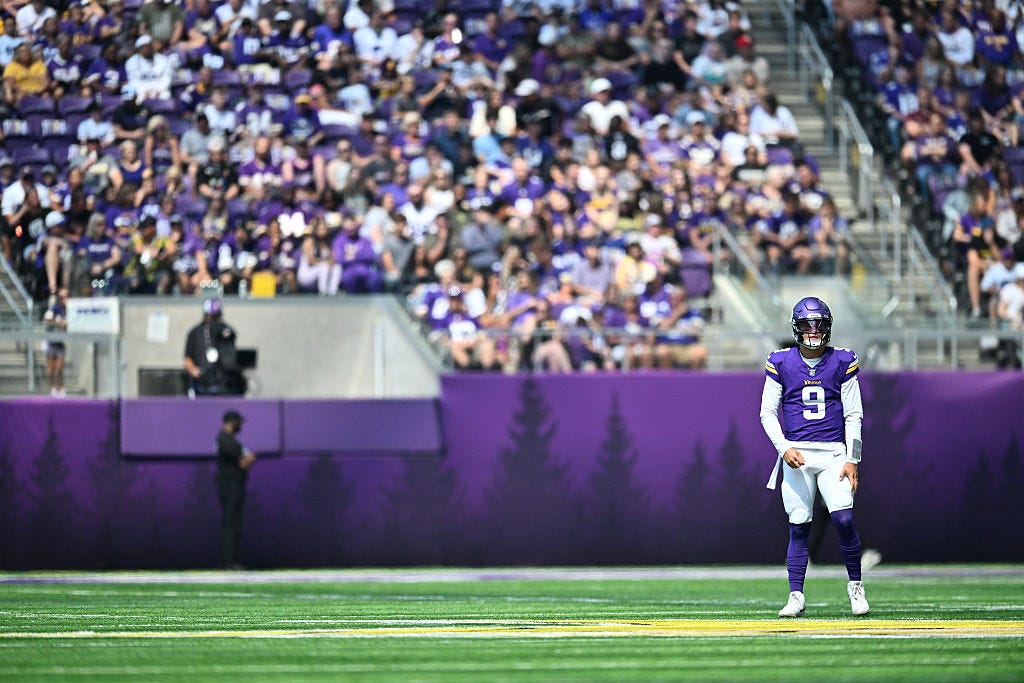
As “beginning of the end” assessments go, Monday’s termination of the J.J. McCarthy project has no shortage of data points for the Minnesota Vikings to draw from.
A line could be traced back to the meniscus tear that halted a vital rookie season for the former Vikings quarterback in 2024. Or when a plan to keep McCarthy paired with a capable veteran starter in 2025 was fumbled away. It could be connected to various lingering injuries, spates of immaturity, mechanical issues — or simply the inability to throw a football with consistent accuracy. Speak to 10 people about when the end began, and you’ll likely get 10 different answers that all share a connective tissue of frustration.
For me, I knew the McCarthy project was over during February’s NFL combine. Long before before Monday’s trade, which sent the third-year quarterback to the New York Giants in exchange for a fifth-round pick.
In late February, I was having a lunch meeting with a league source, attempting to find some shape to the coming offseason quarterback market. For years, the source had showcased an accurate understanding of what the coming veteran QB migration would look like — which quarterbacks were subject to trade offers, which teams were connected with specific free agents, and what the coming wave of contracts would look like. In February, that trade group included McCarthy, who some executives were already counting amongst a group of “pocket listed” players who could get calls if certain scenarios played out.
By the time I traveled to Indianapolis, I had been told McCarthy was a trade candidate. But after my quarterbacks meeting with the source, I knew two things: the Vikings were seeking a new starting quarterback, and McCarthy’s trade clock had realistically begun to tick.
The underlying message? When Minnesota found a viable alternative as a starter for the 2026 season, McCarthy’s future would begin to point out of the franchise.


As I wrote in February, March and April, the reasons why were varied. And they’d be fleshed out over the course of the offseason, as I tried to understand how Vikings head coach Kevin O’Connell went from referring to McCarthy as “our young franchise quarterback” to demoting him to the No. 3 spot to start this season.
After talking with a handful of sources connected to McCarthy, O’Connell, former general manager Kwesi Adofo-Mensah, the Vikings coaching staff and Sam Darnold, here are some of the key circumstances that contributed to McCarthy’s end in Minnesota…
The developmental plan for McCarthy changed quickly
Initially, when the Vikings staff and front office went through their assessment of McCarthy in the draft process, the first plan was to have him begin his rookie season as the team’s No. 3 quarterback. Over time, McCarthy would absorb O’Connell’s offense, work on his mechanics and eventually be considered for a move into the backup role behind Sam Darnold. Patience would be king.

That “No. 3” plan went out the window almost immediately in McCarthy’s rookie training camp. He put together two weeks of practice that had the coaching staff and front office buzzing, then added a sharp preseason performance against the Las Vegas Raiders. By the time the Vikings were heading to face the Cleveland Browns in joint practices of that 2024 training camp, McCarthy had been elevated to the backup spot and was heading into a legitimate competition with Darnold to be the Week 1 starter. While there’s an argument to be made that McCarthy earned his way into a competition, some believe the abandoning of the initial slow-and-steady plan foreshadowed something about patience…or lack of it.
Then came the injury
The meniscus injury that McCarthy suffered midway through his rookie training camp was more severe than initially thought, knocking him out for his rookie season. This complicated matters on a number of fronts. There were the lost reps, the inability to drill on his mechanics, and now the mental hurdles that McCarthy was going to have to endure watching Darnold lead the team. As one source put it, the injury reality “gutted” everyone involved, from McCarthy to the coaching staff and front office.
But there was another layer to the problem, too. McCarthy was coming out of a Michigan passing offense that was fundamentally not like the one that O’Connell operated in Minnesota. There were scheme overlaps in the run concepts, but McCarthy was not going to play quarterback in Minnesota the way he did at Michigan. The formations, personnel and route concepts were all going to be more complicated and voluminous. Which meant that, naturally, he was going to have sizable struggles to overcome even if he had stayed healthy. Which he did not.
Concerning maturity and focus
One source said McCarthy was known as a “pleaser.” And 90 percent of the time, he was giving everything the coaching staff and front office were looking for. But there was a 10 percent margin that also gave pause, and it was usually just tied to maturity and focus. “Acting JJ-ish” was a phrase some have used. In quarterback meetings, there were moments when he either seemed distracted or spent time focusing on details that didn’t matter. Some of this can sound petty and insignificant to the outside world, but coaches from the Sean McVay/Kyle Shanahan tree have a high level of expectation when it comes to their quarterbacks being hyper-focused in preparation.


As one source described it, little things can eventually weave into larger perceptions about personality and seriousness. When young quarterbacks are thrust into a position to lead immediately, organizations expect them to grow up fast when it comes to interactions and projections to the surrounding team. Some of this bled over into the public eye, too. Notably when McCarthy spoke to the media about having a different persona during games that he called “Nine.” From a perception standpoint, it landed awkwardly with some inside the franchise.
The plan to keep McCarthy paired with a veteran in 2025
As the 2024 season progressed, there was a hope inside the Vikings to keep McCarthy paired with Darnold for another season. But after Darnold led the Vikings to a 14-3 record, there was a perception by some in the building that both players were looking at a future in Minnesota in “me or him” terms. McCarthy had been preparing to be the Vikings’ franchise quarterback, and Darnold felt like his play had earned him a legitimate long-term commitment.
Minnesota believed it also had a second option on the table if it couldn’t walk a tightrope and keep both Darnold and McCarthy in the fold: Daniel Jones. But this is where hindsight haunts the Vikings. Jones could have been put to a contract decision before the franchise tag deadline. In that scenario, if Jones told the Vikings he wasn’t signing a deal to remain in 2025, the Vikings could have pivoted and put a franchise tag on Darnold, then worked to iron out whatever awkwardness existed in the quarterback room moving forward.

Ultimately, Jones wasn’t put to a decision before the tag deadline. Darnold went to free agency, and Jones later chose to sign a one-year deal with the Indianapolis Colts, seeing a cleaner path to a starting job and a potential long-term deal. That’s how the Vikings lost their preferred plan to keep McCarthy paired with a capable veteran in 2025. The result was McCarthy ascending to the starting job in 2025 — which, in hindsight, was too soon.
Frustrating injuries and poor performances
Before I get into this part of McCarthy’s issues, I’ll just reiterate that this is where the whole patience debate kicks back in. McCarthy was drafted with a patient developmental path in mind. Due to a litany of circumstances, that imploded. There’s an argument to be made that the Vikings could have pressed on with him through the problems, even if it meant taking a step back as a team. But there is a counterargument to this approach, too — especially when you have an otherwise talented roster. I am reminded of what Bill Walsh said about this in Finding the Winning Edge, which is considered by many across the NFL to be arguably the greatest franchise-building manual ever written.
In Walsh’s words:
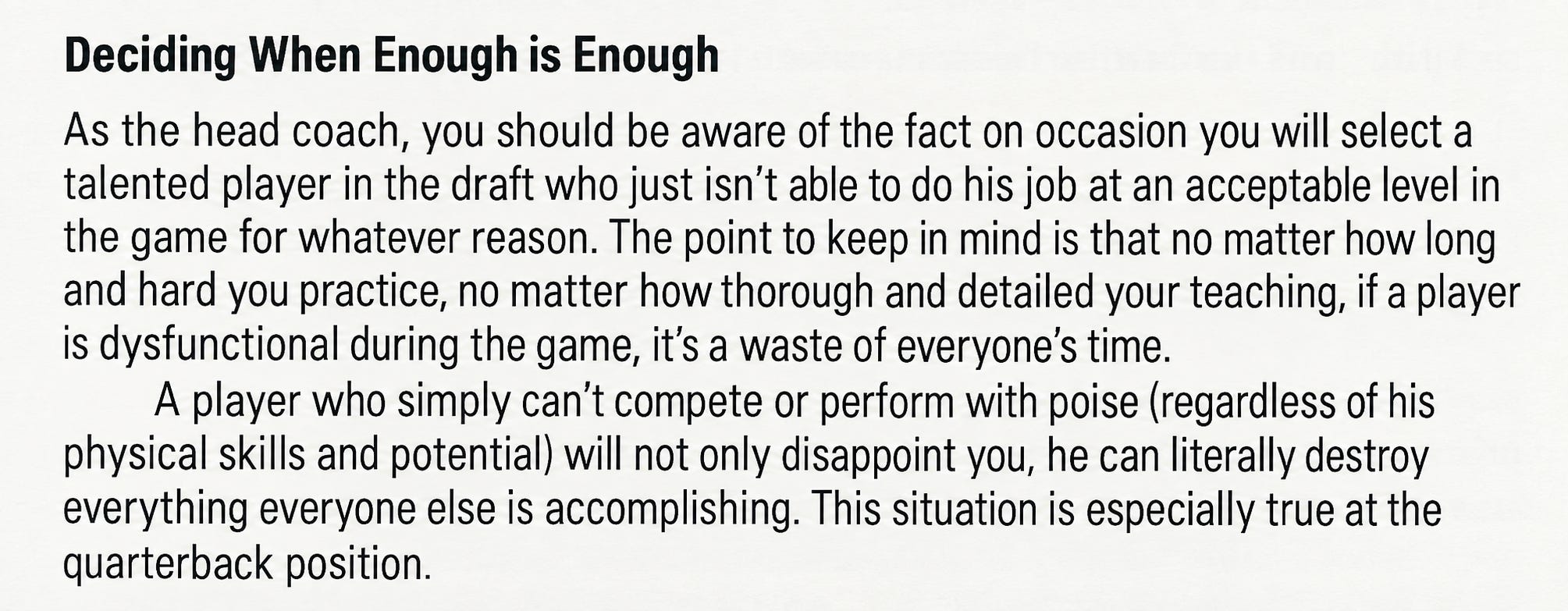
If the Vikings believe McCarthy falls into this category, then the only choice was to trade him. And that’s where a measurement of his injuries and football development comes in.
Beyond the meniscus tear that cost him the 2024 season, McCarthy also dealt with a high ankle sprain, concussion, and hairline fracture in his throwing hand — all in his second year. The result was missing seven starts in 2025 that were vital to work on mechanics that needed continued refinement. The coaching staff tried to work through that during the 2025 season, and it was met with poor results.
The frustration of some in the franchise was that McCarthy simply wasn’t accurate enough. He missed too many throws. And not just difficult ones. He missed opportunities that were engineered for him to get simple completions. Whether it was his ball placement, throwing with proper situational velocity, body mechanics, identifying defensive coverages, making proper calls at the line, or any number of other issues, there was a realization that McCarthy had a much longer road than anticipated to develop as a passer in O’Connell’s offense.
As one source put it, “If J.J. completed just three more passes a game — layups — we’re probably not even having these conversations.”
The Vikings figured that issue out after drafting McCarthy, and it can be traced back to his limited number of pass attempts while playing at Michigan. McCarthy averaged just over 22 pass attempts per game in his two years as the Wolverines’ starter. He also rarely had to carry the Michigan offense in Jim Harbaugh’s run-dominated scheme. The result? The level of his passing ability became a projection, with coaches and evaluators essentially surmising, “Well, if Michigan had thrown it more, then McCarthy’s skillset would look like this.”
When you put all of this together, McCarthy’s failure in Minnesota is something that has to be owned by the entire organization — and by McCarthy. For two years, there were blinking red lights everywhere. Which is how you end up trading a coveted high quarterback pick after only two years. This happens with quarterbacks. Dredge up everything that went wrong with Trey Lance and the San Francisco 49ers. There is some familiar overlap between the two when it comes to mistakes that were made by both the coaching staff and front office.
Of course, none of it matters now. McCarthy is a New York Giant. Darnold is in Seattle. Jones is in Indianapolis. Adofo-Mensah is in the 49ers front office. And O’Connell is still in Minnesota, staring at a quarterback position that has yet to be resolved.