



The improbable pile of victories — six fourth-quarter game-winning drives and counting — continues to stack up for the Cleveland Browns.
Inside of them, quarterback Deshaun Watson appears to be salvaging his career as a starter. At 31 years old, he’s finally looking healthy and playing confidently. For the first time since the final three games of the 2020 season, Watson has strung together three consecutive starts that produced 300-yard passing performances. And in the coming months, he may lead Cleveland to the playoffs.
This is where it starts to get precarious for the Browns — carefully building a positive long-term path toward the future, but also facing the question about whether Deshaun Watson will be a part of it.
When Browns head coach Todd Monken was asked on Monday whether he and general manager Andrew Berry had discussed Watson’s future beyond this season, he replied simply: “We have not.”
“I really don’t think that far ahead,” Monken said.
Realistically, he might not have that luxury much longer.
At some point — particularly if the winning (and Watson’s part in it) continues to grow — Monken and Berry are going to get pressed for some kind of explanation of what the future could hold. Especially when Monken seems to indicate that he believes in Watson as his quarterback. Monken’s explanation of Watson’s rebound helps explain why that might be the case, too. Recalling a conversation he had with the quarterback after a bad preseason game against the Buffalo Bills, Monken pointed to Watson’s emotional state and accumulated frustration.
“I didn’t see someone who was broken,” Monken said. “I saw someone that was hurt.”
The underlying message? I think Monken saw a path to Watson regaining at least some of the form that has eluded him for years. And now there’s actually some production to back that up. Of course, it hasn’t been perfect by any stretch. Monken pointed out that there’s a lot that still has to get cleaned up — from inconsistent drops and footwork to getting through his progressions and building confidence as the offensive line and young receivers improve. Monken isn’t overtly saying it, but it sounds as if he believes there’s a plausible argument that if he had another year with Watson, there’s still more there to access as a quarterback.
But at what cost? Because there’s not just a complicated financial component here. Now there’s a talent-procurement dilemma, too.
It’s the scenario that few would have believed coming into the season: that Watson would play well enough to drive the Browns into the playoffs, thereby worsening the draft positioning Cleveland needs to take his replacement at quarterback. As it stands, the Browns’ two first-round picks in the 2027 draft would slot at 18th overall (the L.A. Rams pick acquired in the Myles Garrett trade) and 20th (Cleveland’s own pick).
And all the while, Cleveland is faced with a massive dead cap charge that can only be adjusted by working out a new contract extension. Lest anyone forget, the Browns are on the hook for roughly $86.2 million in dead money when Watson is ultimately cut. That will be sliced into $34.66 million on the 2027 cap and $51.54 million on the 2028 cap if he’s designated as a post-June 1 release. He can’t be kept under his current contract, either, thanks to a poison-pill clause that guarantees a $200 million salary in 2029 if he’s on the roster the third day of the new league year in March of 2027.
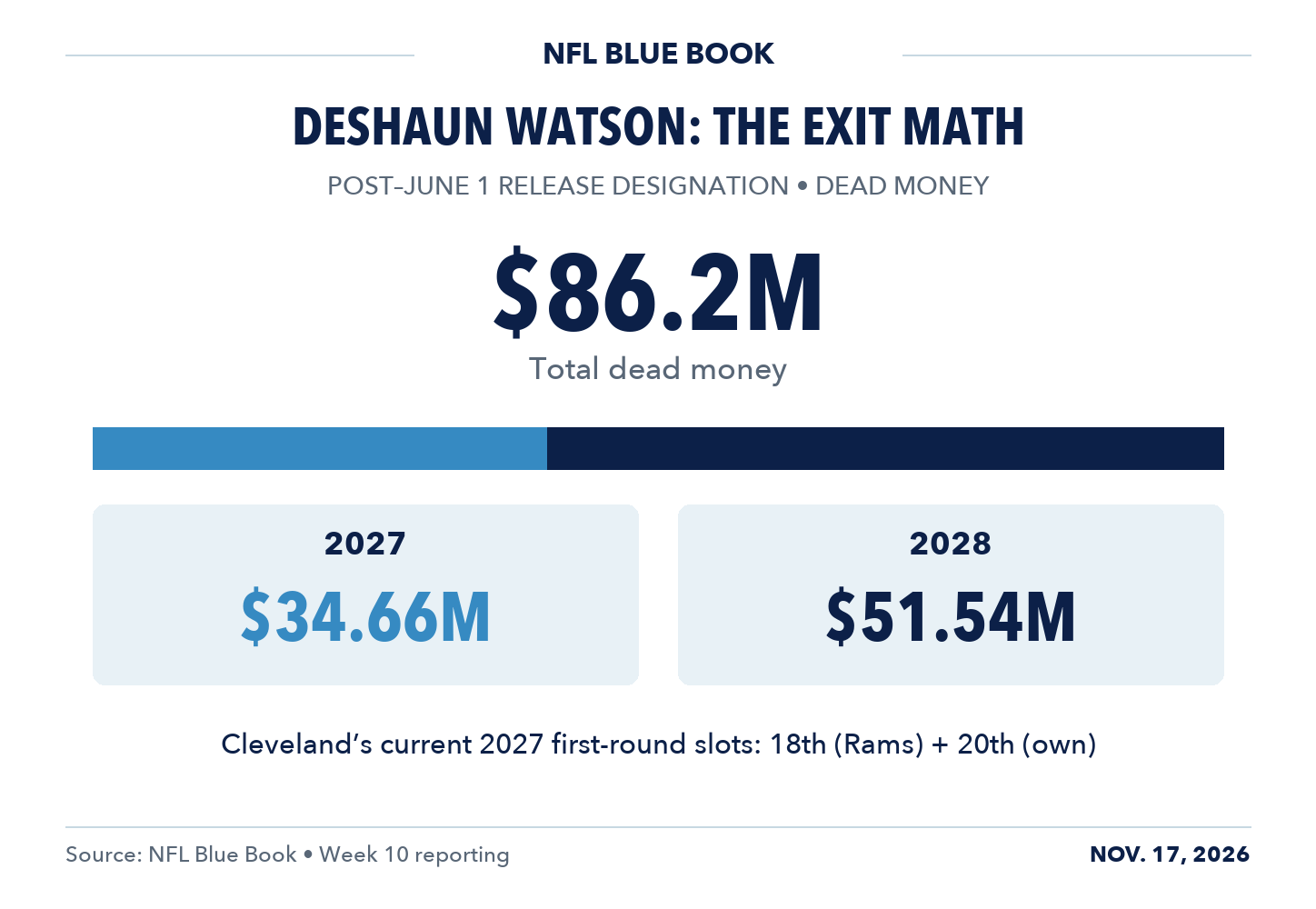
I was curious how other NFL executives saw this playing out. I called a handful. Not one believes Watson will remain in Cleveland, regardless of what he does the remainder of the season. Why? Chiefly, it’s the money that dictates a divorce and the belief around the NFL that Watson is still not going to have many suitors following one middle-of-the-pack season. Frankly, it was a good reminder of how other decision makers across the league continue to see him.
And what they still continue to see is this…
A person who will forever reside under the specter of the settled sexual assault lawsuits, which creates friction in a new fan base no matter how far in the rearview mirror those allegations get.
And a quarterback whose play this season has featured dramatic finishes and some splash moments, but also carried with it significant uneven stretches. At best, some evaluators see Watson as an average-to-below-average quarterback.
“I don’t think he has much leverage at all,” one longtime executive told NFL Blue Book. “I don’t see anyone lining up to pay him. I just don’t see an upside to his situation. … The only decision is to let it play out until you can get out with sensibility. Get out ASAP. [You] can sign him back cheap if you can get out at the right price [with a post-June 1 release designation]. The market will be minimal at best.”
With seven games left, Watson will do what he can to change those attitudes. Meanwhile, Berry, Monken and others will continue to assess whether his performance through the remainder of 2026 is worth the complications of another commitment. Watson getting cut and then coming back on a one-year deal isn’t out of the question. Especially if his market in free agency is soft and the Browns feel locked out of other quarterback options.
I keep going back to a conversation I had last offseason with a high-ranking Browns source. It was early June after the Myles Garrett trade had been completed, and I was going over the roster with the source. What was relayed was crystal clear: the Browns felt like they were in a good spot with the young talent on the roster and were one more offseason from completing the build. And now they had additional draft capital to once again attack a decades-old problem.
“We just need to get the quarterback right,” the source said.
Five months later, the question is still unanswered. But there’s little doubt that Deshaun Watson’s play under Monken is complicating it.
Some other thoughts this week…
Kirk Cousins solved a key offensive problem quickly
Going back and rewatching the Minnesota Vikings’ 30-10 win over the Green Bay Packers, I was struck by some of the clutch moments Cousins delivered on third down. Not just the third-and-23 that he turned into a touchdown, but also a challenging third-and-15 and another third-and-12. What you saw against the Packers was a quarterback that could seamlessly step into coach Kevin O’Connell’s offense and then be cool-headed when it mattered most.

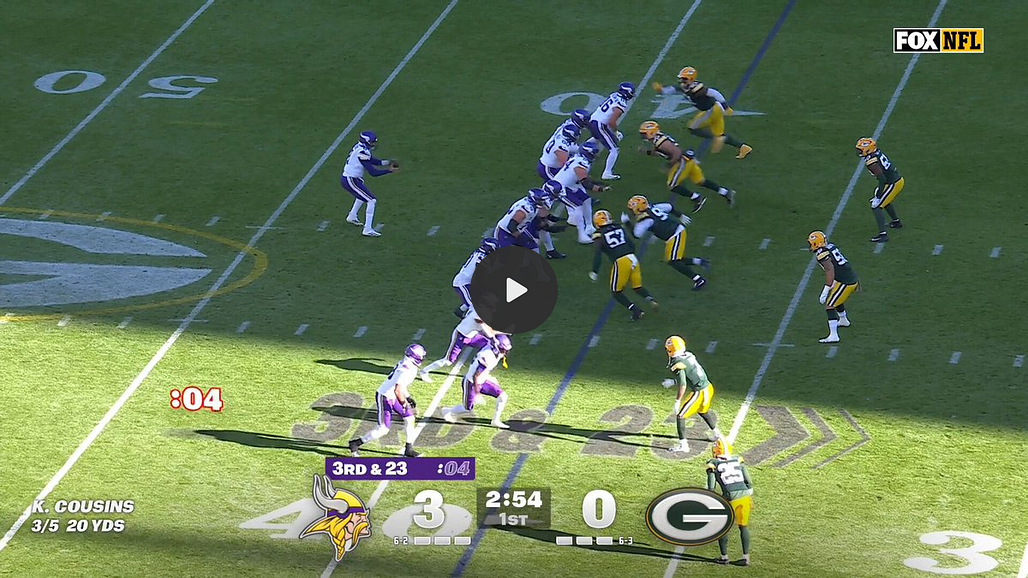
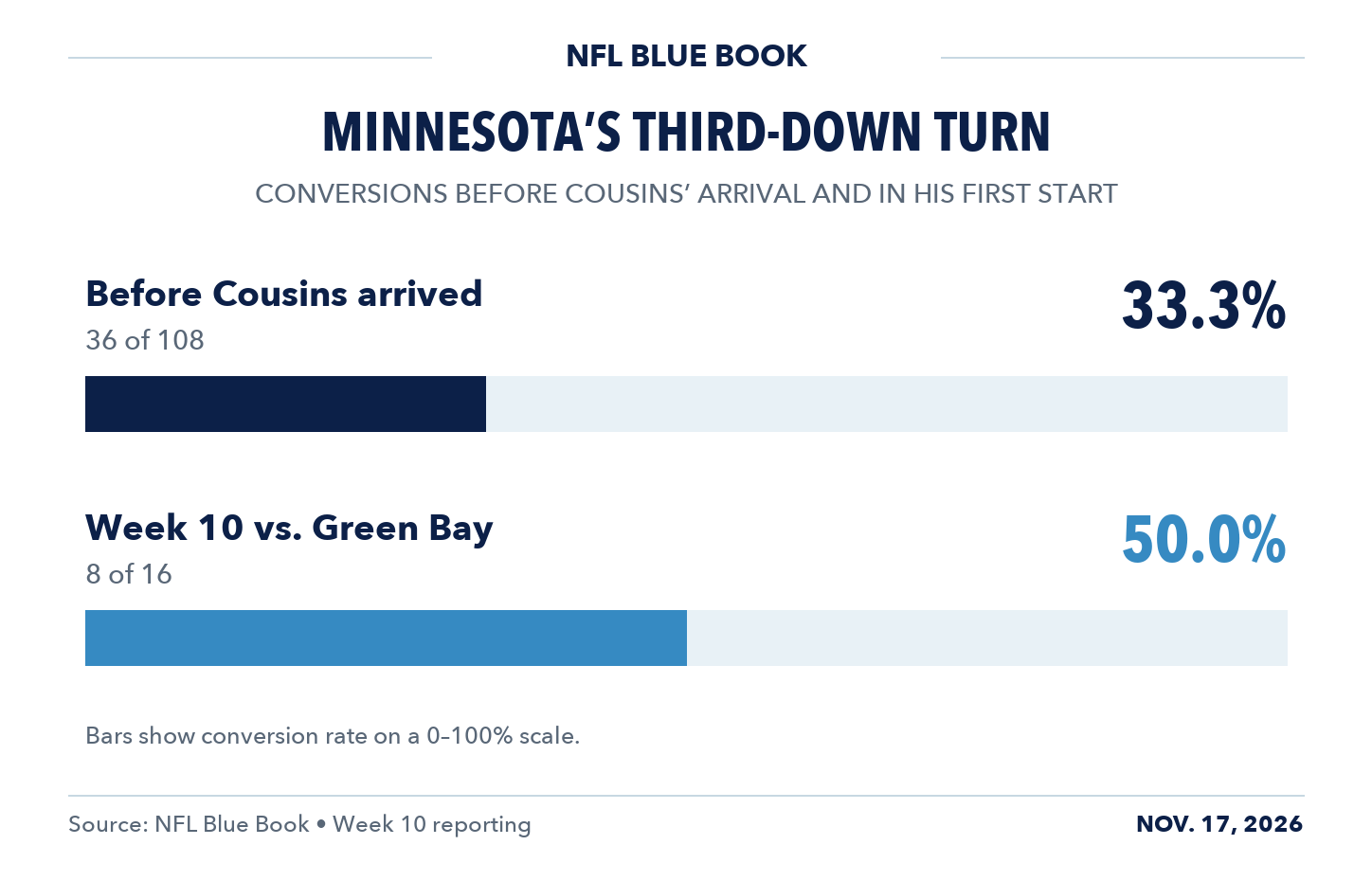
Between Carson Wentz and Max Brosmer, Minnesota was 0-8 on third down in the 23-6 loss to the Buffalo Bills in Week 9. The same unit with Cousins at the helm? It converted 8 of 16 on third down. That kept the offense on the field and took pressure off defensive coordinator Brian Flores’ unit to have to carry the game. Predictably, Flores and the defense were superb with the added balance.
Prior to Cousins arriving, the Vikings had converted 36 of 108 third-down attempts — 33.3 percent. That was 30th in the NFL. Amongst the 28 teams that played in Week 10, Minnesota’s 50 percent third-down conversion rate ranked 5th. This is what you pay a third-round pick for. And if this holds up through the rest of the season, this Vikings team is going to be a problem for the other NFC elites.
Parker Washington is only getting more expensive
I believe the Jacksonville Jaguars could have gotten wideout Parker Washington locked into a long-term deal last offseason slotted in the range of Alec Pierce’s four-year, $114 million extension with the Indianapolis Colts. Barring injury or a catastrophic collapse in his performance, that number is long gone.
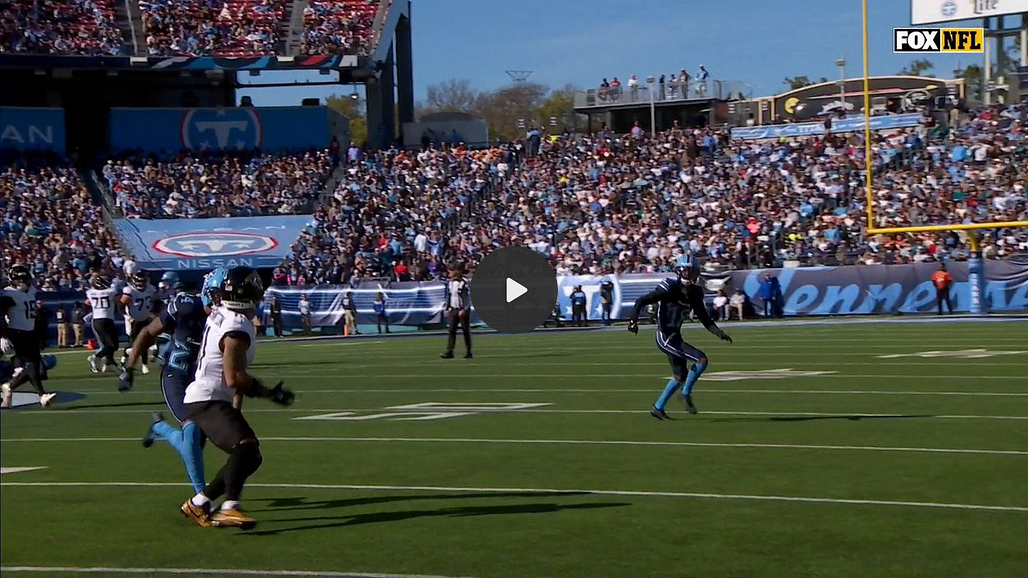
Washington had a brilliant game against the Tennessee Titans, catching seven passes for 152 yards and a superb touchdown. According to Zebra Technologies, Washington hit 21.85 miles per hour on his 50-yard reception. That ranks third on the season’s Next Gen Stats fastest-ball-carrier list.
Yes, Sunday’s performance was against the Titans. But Washington also smoked the Philadelphia Eagles defense for 124 yards and two touchdowns earlier this season.
He’s far and away the Jaguars’ No. 1 wideout. And at the current clip, Washington is on pace for 1,218 yards and 11 touchdowns. Just as a baseline, that would put Washington’s extension shoulder-to-shoulder with the four-year, $140 million deal signed by Baltimore Ravens wideout Zay Flowers. But Washington could exceed that by a solid margin if he actually makes it to free agency, with cap-rich teams like the Las Vegas Raiders, Washington Commanders and Miami Dolphins all expected to be shopping for a No. 1 wideout next offseason.
So what does this mean for the Jaguars and Washington? At the very least, I think they’ll apply the franchise tag to him, which is currently projecting at roughly $30.9 million.
I don’t think Washington’s camp is going to be thrilled with that outcome, given that a deal averaging $40 million could be waiting for him in free agency. This situation could get very uncomfortable come March.
Other odds and ends…
I thought Fernando Mendoza had a solid first start against the Seattle Seahawks, finishing 17-for-29 for 143 passing yards and also adding a rushing touchdown. But as I rewatched the game, the six sacks made me a little more nervous. Kirk Cousins had only been sacked 11 times in nine starts. A lot of that is attributable to Cousins being a veteran who knows when he’s got to get the ball out, throw it away, or take a quickly identified option when checking down.
Mendoza has got plenty of work to do. On one of the sacks, he set up too deeply in the pocket and then didn’t climb up when the pressure necessitated it. On two others, he wasn’t able to recognize corner blitzes.
These are the kinds of things that happen when a rookie is getting his first start. And Mendoza was facing a top-tier Seattle defense. But those sacks are going to be something to monitor moving forward.
Tony Pollard’s rushing performance was stunted in the Tennessee Titans’ 40-23 loss to the Jaguars, but you could still see why Titans general manager Mike Borgonzi held onto Pollard through the deadline. The Titans’ season is now entirely geared toward getting quarterback Cam Ward onto an upward trajectory, and Pollard is going to do some of the dirty work that Ward will need. If you want a prime example, check out Pollard’s 32-yard catch-and-run touchdown on Sunday. He broke three tackles and dragged a fourth defender into the end zone on the play. The play resonated when I saw it, because one of the things Borgonzi talked about in training camp was getting Ward to take easy plays when they’re available. The dump-off to Pollard in this instance was exactly that. And then Pollard turned it into a touchdown for his quarterback.
Expect to see more of rookie running back Seth McGowan down the stretch for the Indianapolis Colts. While Indianapolis didn’t trade Jonathan Taylor at the deadline, I think that will be revisited in the coming offseason by the next general manager. And I think McGowan’s usage is going to be the tell. He ran 12 times for 77 yards and a touchdown in the Colts’ 24-22 win over the Miami Dolphins. In the previous nine games, McGowan got more than six rushing attempts only once. I think he’s going to get more opportunities down the stretch for the Colts, who are going to be poking around the younger parts of the roster to see what they have moving forward. That will also take some wear and tear off Taylor, preserving his value if the right deal surfaces in the offseason.
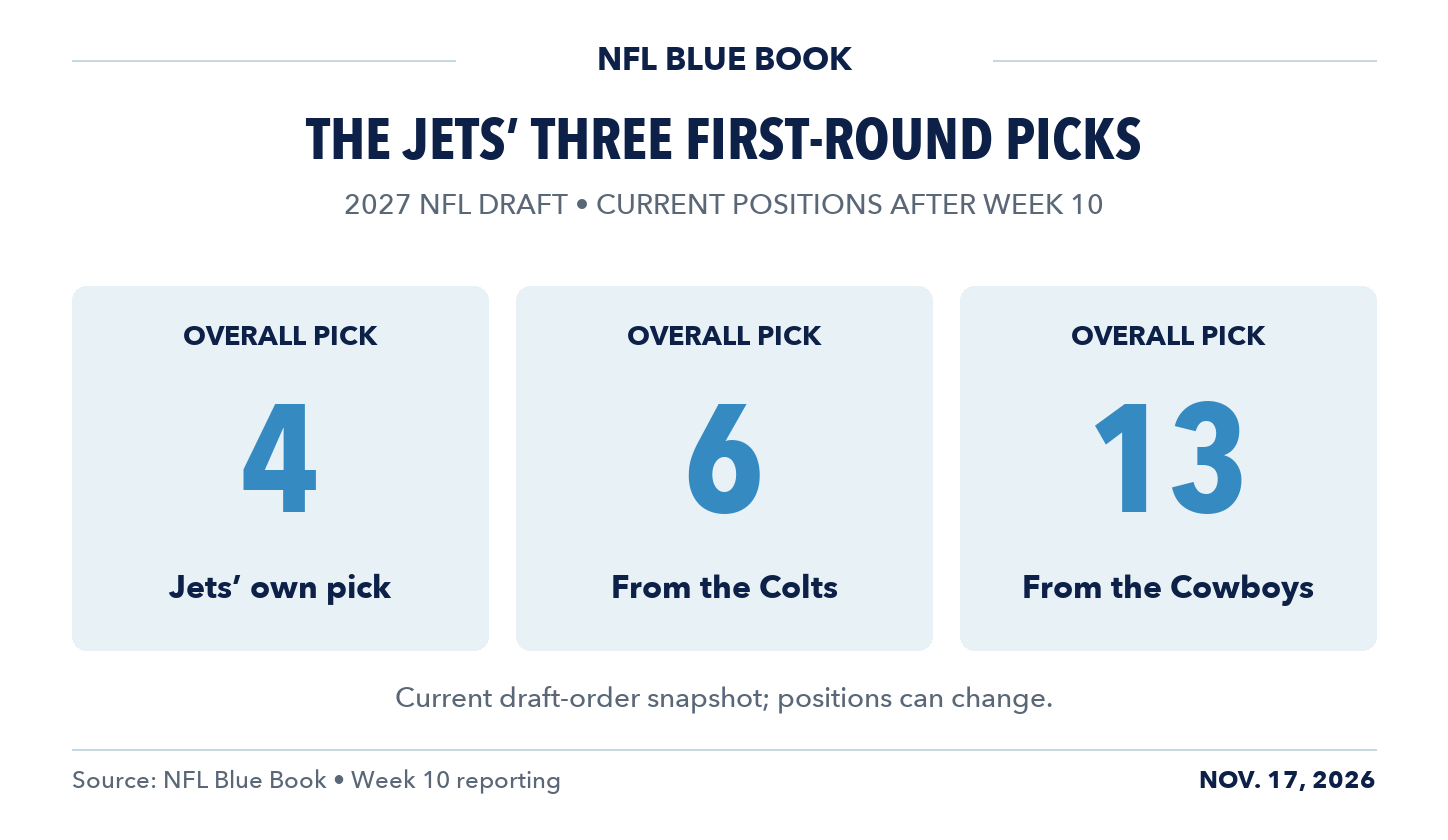
I am going to be very interested to see what New York Jets general manager Darren Mougey does next offseason. The Jets’ three first-round picks in the 2027 draft — including their own, the Colts’ pick and the Cowboys’ pick — currently slot at 4th, 6th and 13th overall.
The last NFL team to have three picks inside the top 13? It was the Chicago Bears in 1965. The players Chicago selected were a pair of Hall of Famers in linebacker Dick Butkus (third overall) and running back Gale Sayers (fourth overall) and defensive end Steve DeLong (sixth overall). And DeLong ultimately signed with the AFL’s San Diego Chargers rather than the Bears, so the Jets could be the first team in the NFL’s Super Bowl era to actually draft and sign three rookies taken inside the top 13 picks.
The bigger question may be whether Mougey sticks and picks or moves some of that capital either to position himself for the quarterback of his choice or to trade for a veteran starter.
That’s some really insightful stuff about Watson. I agree that he doesn’t have any leverage at all to be demanding a starter spot next year. But this is a crazy league, and I can see a future where he is signed to the Titans on a one year deal to compete with Cam Ward.