



Two years ago, Marvin Harrison Jr. was coming off what would be his best back-to-back turn as an Arizona Cardinal. His second and third games of the 2024 season had seen the rookie wideout put up nine catches for 194 yards and three touchdowns, stoking the seemingly league-wide belief that a generational receiver was officially on his way.
Now 32 games into his NFL career, the only thing generational about Harrison Jr. has been his stunningly fast disappearance.
It’s a precipitous drop that stretched through Week 3 of this season, with the Cardinals wideout catching three passes for 40 yards in a 36-30 loss to the San Francisco 49ers. That stat line raised his season production to 73 yards on four catches and an anemic nine targets. And while it represented a bump over Harrison Jr.’s virtual nonexistence in the first two weeks, it’s hard to ignore that his five targets against the 49ers came in a game that saw Arizona quarterback Jacoby Brissett throw 52 times. Which means that in what is now considered an “encouraging” game, Harrison Jr. had a 9.6-percent target share.
That’s the percentage of a player who is the fourth option in the passing game. At best. Which continues to telegraph the reality surrounding Harrison Jr. in this Cardinals core game plan. We don’t have to ask head coach Mike LaFleur what role Harrison Jr. holds in his offense, because LaFleur’s offense has already told us for three consecutive weeks. More than anything else, Harrison Jr. is filling the role of being a decoy. And the less he produces in that role, the less valuable he will become. To the point that even the decoy role won’t really work.

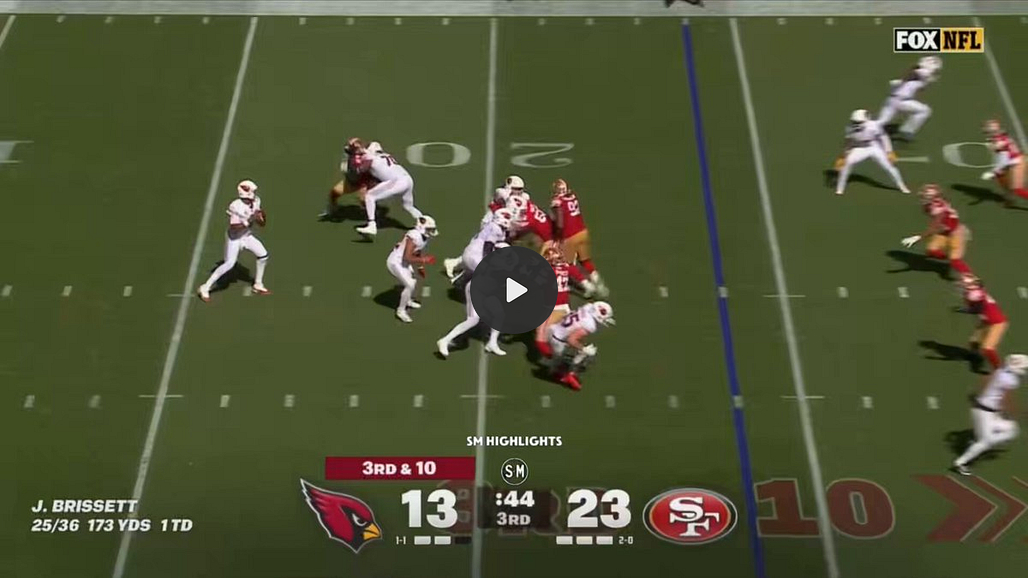
This is what has fueled the trade speculation around Harrison Jr. He looks like a player who has been phased out of the offense for any variety of reasons. Whether it’s lack of separation, lack of effort, poor routes or just a misalignment with the culture this Arizona Cardinals coaching staff is trying to build, it’s not meshing with whatever Harrison Jr. is still capable of bringing to the table.
With that in mind, I spoke to seven front offices over the course of last week — three general managers and four high-ranking personnel executives — attempting to gauge Harrison Jr.’s potential value on the block. This is what I was told…
What is Marvin Harrison Jr. worth?
To one general manager, there is value.
“He is a player that is getting judged relative to what he was supposed to be, while people are losing sight of the fact that he is still a useful player,” the GM said.
So what is a useful player like Harrison Jr. worth on the trade market?
As with any attempt to dial in a player’s market, it’s a sliding scale of value depending on who you speak with. Depending on the age of the player and the circumstances on his current team, some personnel departments are willing to continue leaning heavily on the strength of a player’s college tape and their own internal scouting assessment leading into a draft. If they feel there are circumstances that have caused a player to have a capped ceiling, they are willing to factor that heavily into the trade value assigned to a player.
Conversely, other personnel departments orbit more closely around what a player has shown on the NFL level. Regardless of whether their college tape was superb and an internal scouting report assigned a high grade, these departments prefer a “believe what a player has shown you” approach. The belief being that if a great college player has struggled on the NFL level — especially with things they can control like effort and attitude — then that’s more likely the most accurate representation of who that player is.
Interestingly, the analysis of Harrison Jr.’s trade value fit solidly into those two categories between the seven personnel departments. The result? These three categories emerged:
Harrison Jr. is still worth a second-round pick that is projected to be late.
Three front offices agreed on this, and it was largely based on how they viewed Harrison Jr.’s talent level coming out of Ohio State in 2024, and the uneven nature of the Arizona Cardinals franchise that he was drafted into.
“[His situation in Arizona] has been a strange deal since he entered the league,” one general manager said. “He doesn’t play with a lot of urgency on tape. I could still see a playoff team with a wide receiver need taking a swing on the college tape with a second-round pick.”
Added another personnel executive, “I think what we saw at Ohio State is still in there. But [in just over two seasons] he’s had two coaching staffs, [two] quarterbacks, an injury — it fits into the production and probably where his head is. … Football environment comes out. That’s not meant to criticize this [current] Arizona coaching staff, either. I’m sure they inherited whatever happened with Marvin in 2025.”
Harrison Jr. is worth a third-round pick (plus another asset)
The four remaining front offices, including two general managers, fell into this category. The “plus” portion of their suggestions varied between adding a fifth or sixth-round pick, or arranging some form of late-round pick swaps. One general manager pointed at the George Pickens trade between the Pittsburgh Steelers and Dallas Cowboys (which I previously mentioned in a notes column). In that deal, the Steelers sent Pickens to the Cowboys for third and fifth-round picks, while Dallas received Pickens and a sixth.
“That [trade] would have looked different if Pickens didn’t have the maturity [red flags],” a general manager said. “[Pittsburgh GM Omar Khan] was getting pennies on the dollar versus the on-field ability. I don’t think Marvin has that kind of reputation, but I also don’t think he’s as talented as Pickens. But that value feels right. You can also be creative and add some conditional terms to the picks, too.”
One high-ranking executive agreed on the value but did question Harrison Jr.’s intangibles based on what he’s seen this season.
“I was watching the Seattle game and it looks like he doesn’t want to be out there,” the executive said. “Coming out [of Ohio State], the intangibles were supposed to be high level. He’d still be worth a third, plus. I haven’t studied, I’m just guessing enough college grades would carry him.”
Harrison is worth a 1-for-1 swap for talent that no longer fits the staff or scheme
This suggestion came from a general manager who fell into the “third, plus” draft pick category. The GM offered it as a creative solution that can sometimes work when two teams have players they feel are worth more in terms of draft pick compensation, but also know they’re going to have a hard time getting another franchise to reach common ground on the value. The GM pointed to a deal this past offseason, when the Tennessee Titans traded defensive tackle T’Vondre Sweat to the New York Jets for pass rusher Jermaine Johnson in a 1-for-1 deal.
“I thought that was a really smart trade,” the GM said. “Two guys with good talent, both still young, but they needed change and a better scheme and coaching marriage. If the Cardinals want to get a receiver back in exchange for Marvin, that [2024] class has some high picks in the same situation.”
One in particular resonated with the general manager: Jacksonville Jaguars wideout Brian Thomas Jr., who had a blistering rookie season in 2024 but has since fallen outside the core offensive scheme since the arrival of head coach Liam Coen in 2025. Through three games this season, Thomas Jr. has seven catches for 88 yards on 13 targets. Like Harrison Jr. this season, Thomas Jr. also appears to be no better than the fourth option in the Jacksonville offense.
Such a deal would also resolve a tricky part of a team trading for Harrison Jr. — or Thomas Jr. for that matter. As members of the 2024 first-round class, both players have fifth-year options that need to be triggered by May. If their teams pass on picking up that option, the players become free agents after the 2027 season. According to Over The Cap, Harrison Jr.’s fifth-year option is currently projected at $18.95 million for the 2028 season. Thomas Jr.’s is projected at $17.2 million.
That means acquiring either player in trade for draft picks would be essentially renting them for the remainder of 2026 and the 2027 season. In theory, it’s more palatable to exchange a rental player for a rental player than to buy a rental player for draft picks.
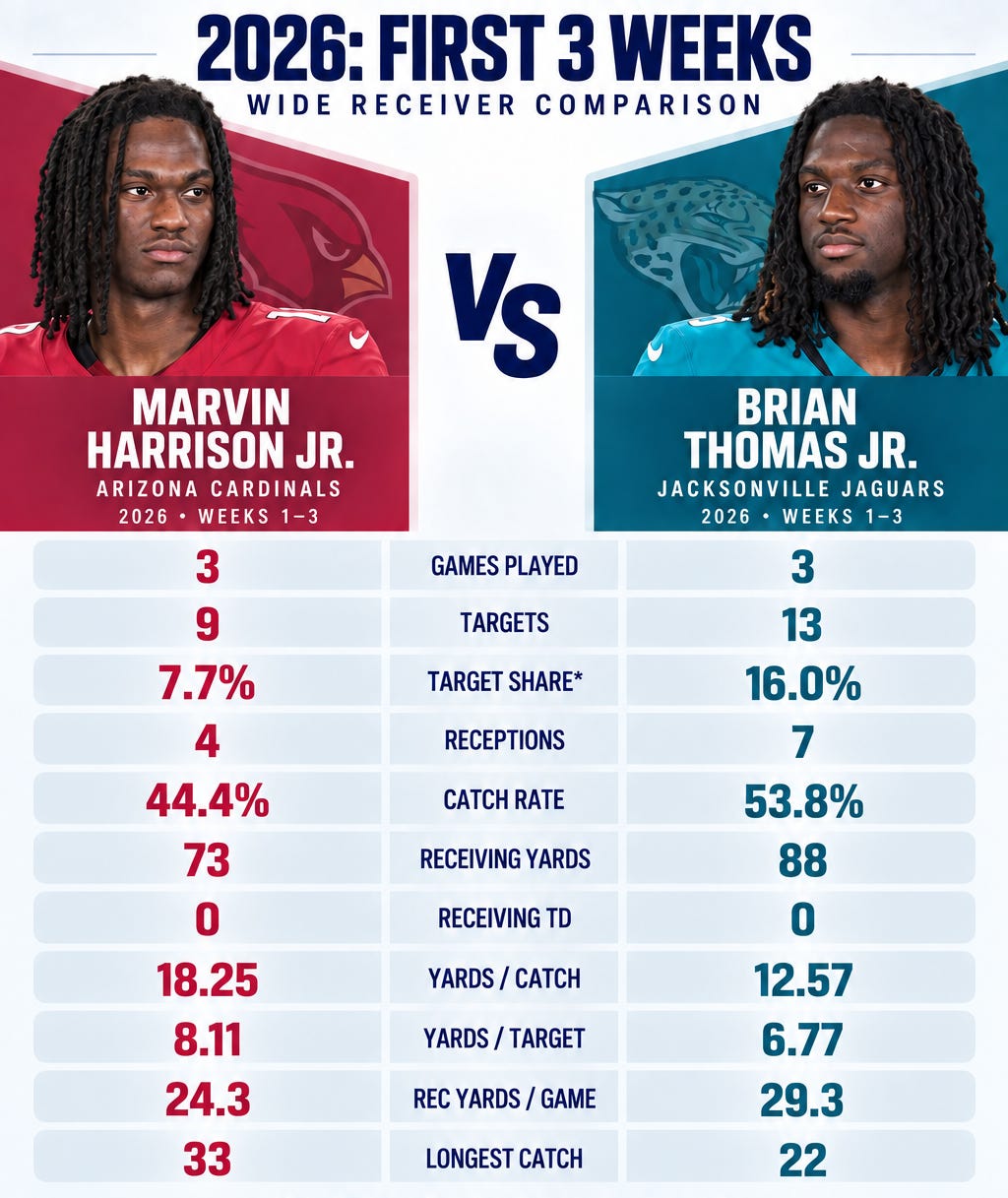
What trade partners make sense when it comes to Harrison Jr.?
There are three schools of thought on this.
First: Rule out the LaFleur/McVay/Shanahan coaching staffs. If Harrison Jr. isn’t working in Mike LaFleur’s scheme, the reasons why are going to get shared through this coaching tree. That poisons the trade well with franchises that have ties and access to Mike LaFleur’s mindset when it comes to Harrison Jr.’s fit in the scheme.
Second: Seek familiarity in the times that Harrison Jr. has had success. The most obvious connection would be the Houston Texans, whose starting quarterback C.J. Stroud overlapped with Harrison Jr. in 2022 when the wideout exploded to stardom. The Texans have wideout needs and Stroud and Harrison Jr. once shared a strong connection at Ohio State. After Stroud, the next most prominent connection, from what I’ve been told, is Buffalo Bills wide receivers coach Drew Terrell. Terrell was the wide receivers coach and passing game coordinator for the Arizona Cardinals in 2024 and 2025, which gives him firsthand experience and overlap with Harrison Jr. when he had his most success at the NFL level. Another Bills bonus? Like Thomas Jr. in Jacksonville and that 1-for-1 scenario, Buffalo wideout Keon Coleman also appears to be a fresh-start trade candidate who can’t find footing in the team’s offense.
Third: Straight-up need. Teams like the New England Patriots, Kansas City Chiefs, Pittsburgh Steelers, Las Vegas Raiders and Indianapolis Colts all have needs at wideout. The Texans and Bills also fall squarely into this category. Given all the variables, the Texans’ need and Stroud’s history with Harrison Jr. at Ohio State would seem to put the Texans into a sweet spot when it comes to setting up for success.


Of course, Harrison Jr. and the Cardinals could turn this all into wasted energy in the coming weeks. If Sunday’s very slight uptick in Harrison Jr.’s production is a larger indicator of him starting a path back to relevancy in the offense, we should be able to see it in the next two weeks, when the Cardinals face the New York Giants and Detroit Lions. The Giants are in the middle of the pack when it comes to defensive passing metrics, while the Detroit Lions are dead last — or close to it — in most key measures. If Harrison Jr. is just now starting his upward trek in Mike LaFleur’s scheme, we should see it the next two weeks.
And if he isn’t?
Keep an eye on what teams get desperate at the wide receiver spot and also the Nov. 10 trade deadline. Particularly if the Cardinals fall out of postseason contention in the next six weeks. Arizona faces five potential playoff teams in those six games — or six if you want to include the 2-1 Giants. If this season falls flat in those six weeks…and if Harrison Jr. continues to fall flat with it … the odds of a trade are only going to intensify.