


The most pertinent Lamar Jackson question came late for Baltimore Ravens coach Jesse Minter. Predictably, the interpretation was muddled, at best.
Speaking to reporters in his Monday press conference — in which he provided few details about the nature and recovery timeline regarding his quarterback’s thumb injury and forthcoming surgery — Minter was asked about the future. It was arguably the most important question of the press conference regarding Jackson. Unfortunately, there was wiggle room in the answer.
The query from a reporter: “Jesse, I mean, there’s been no shortage of people over the last 24 hours wondering, is it possible we won’t see Lamar in a Ravens uniform again? Is that something you’ve even thought about?”
Minter’s response: “No.”
Clearly, Minter was answering the second part of the question. As in — no, he hadn’t thought about it. What everyone really wants answered is the setup: is it possible we won’t see Lamar in a Ravens uniform again? Minter didn’t answer it, because that wasn’t the actual question. Instead, he told the outside world that he isn’t thinking about Jackson having appeared in a Ravens uniform for the last time on Sunday, when the quarterback suffered a thumb injury that could potentially end his season.
Well, I suppose it’s good that Minter isn’t thinking about it. Because seemingly everyone in the media world is.
Monday morning was awash in analyst commentary about whether Jackson had played his final snap in Baltimore. Talk shows. Radio shows. Everywhere on social media. All without regard to two important questions: Is that what Jackson wants, and is there a suitor out there that is willing to gamble on his talent after a swath of injuries that have cost him games four of his last six seasons?
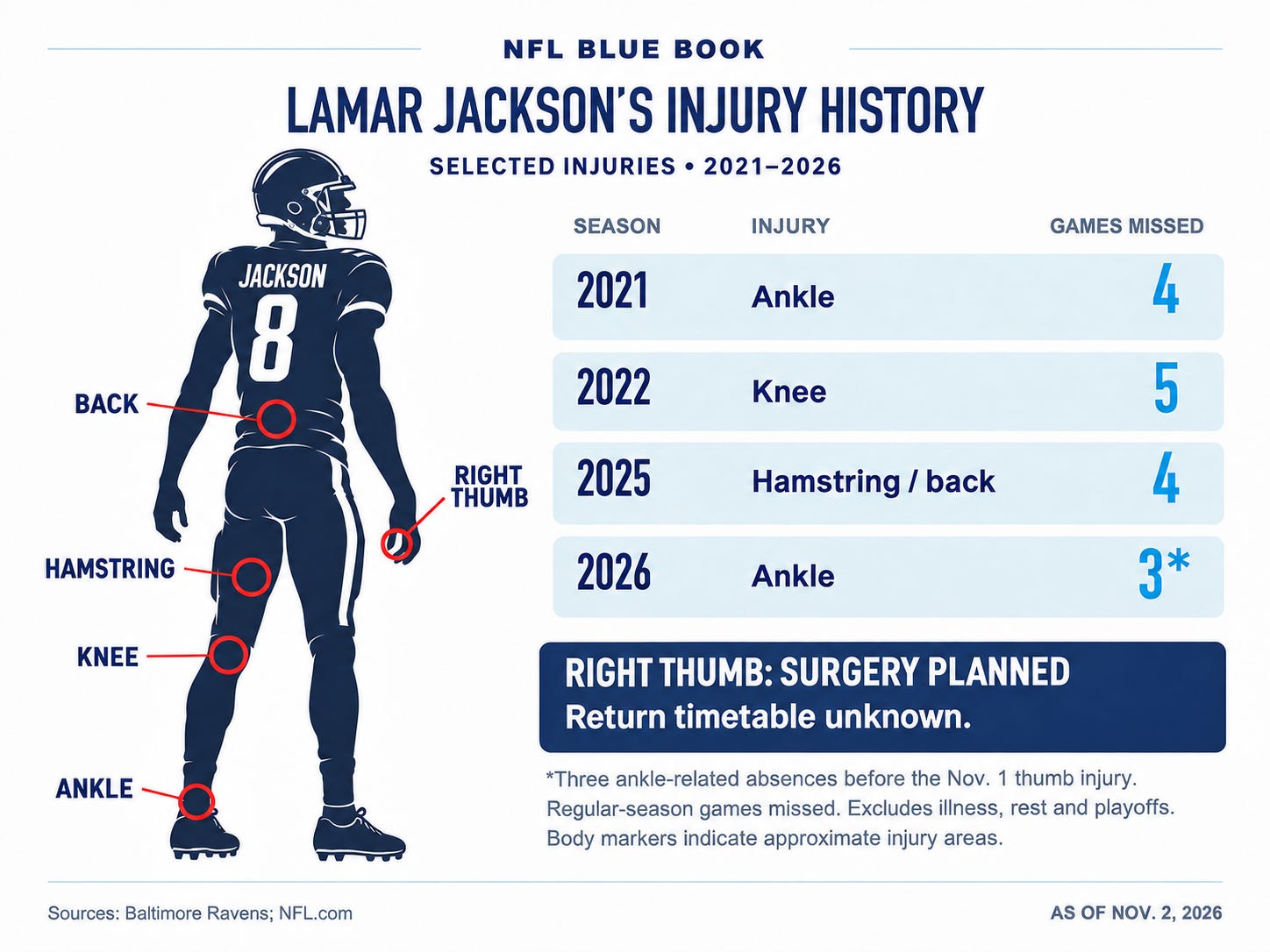
After all, Jackson is under contract through the 2027 season, with Baltimore already seeking an extension that is expected to make him the highest-paid quarterback in NFL history. Who is willing to pay that price? Or more importantly, who is willing to pay that price and also surrender trade assets for Jackson? I was curious, so I picked the brains of a handful of league executives over the course of Monday. And the responses were not quite as simple as the commentary on Monday.
“He should probably be done there,” one longtime high-ranking evaluator said of Jackson and the Ravens. “But I feel like they’ve always been myopic when it comes to him. There are [long-term] flaws, but I think they have blinders on.”
The long-term flaws? Injuries, Jackson’s history of missing in-season practices, his playoff failures, and also contract stress that has hung over the organization during his last two rounds of extension talks. I asked if the “blinders” were driven by ownership or the front office.
“I feel like it’s [current general manager Eric] DeCosta and probably [previous GM] Ozzie [Newsome],” the executive continued. “I would think ownership would be leery by now.”
Of course, the vantage changes from one franchise to the next. One executive with a deep familiarity with DeCosta and Newsome opined: “Without Ozzie on the bow, it has probably run its course.” But another AFC executive noted, “[Jackson’s] game and style of play lends itself to some injury risk — but he’s still one of the best.”
When you start sifting through all of it, what you end up with is this: Nine years into his career, there are still split opinions about Jackson, and there’s really no firm grasp of his Ravens future. In a way, it all squares with Minter’s answer on Monday. He doesn’t think about Sunday being Lamar Jackson’s last game in a Ravens uniform. But he also didn’t declare for sure that it wasn’t. Most likely because he doesn’t really know.
So what do we know?
Jackson’s contract situation in Baltimore isn’t simple
The Ravens and DeCosta have been pushing to resolve Jackson’s contract extension since last January — following an unforgettable statement from owner Steve Bisciotti, who declared early in the offseason: “I don’t want to go into free agency with that hanging over our head.”
Of course, March arrived without an agreement, forcing DeCosta to restructure Jackson’s deal to create a much-needed $40 million in cap space. The Baltimore GM would later call it an instance of running out of time, leaving the franchise to push future cap accounting into later years. The result was an $84.34 million cap charge in 2027 that is bobbing on the horizon like a financial iceberg.
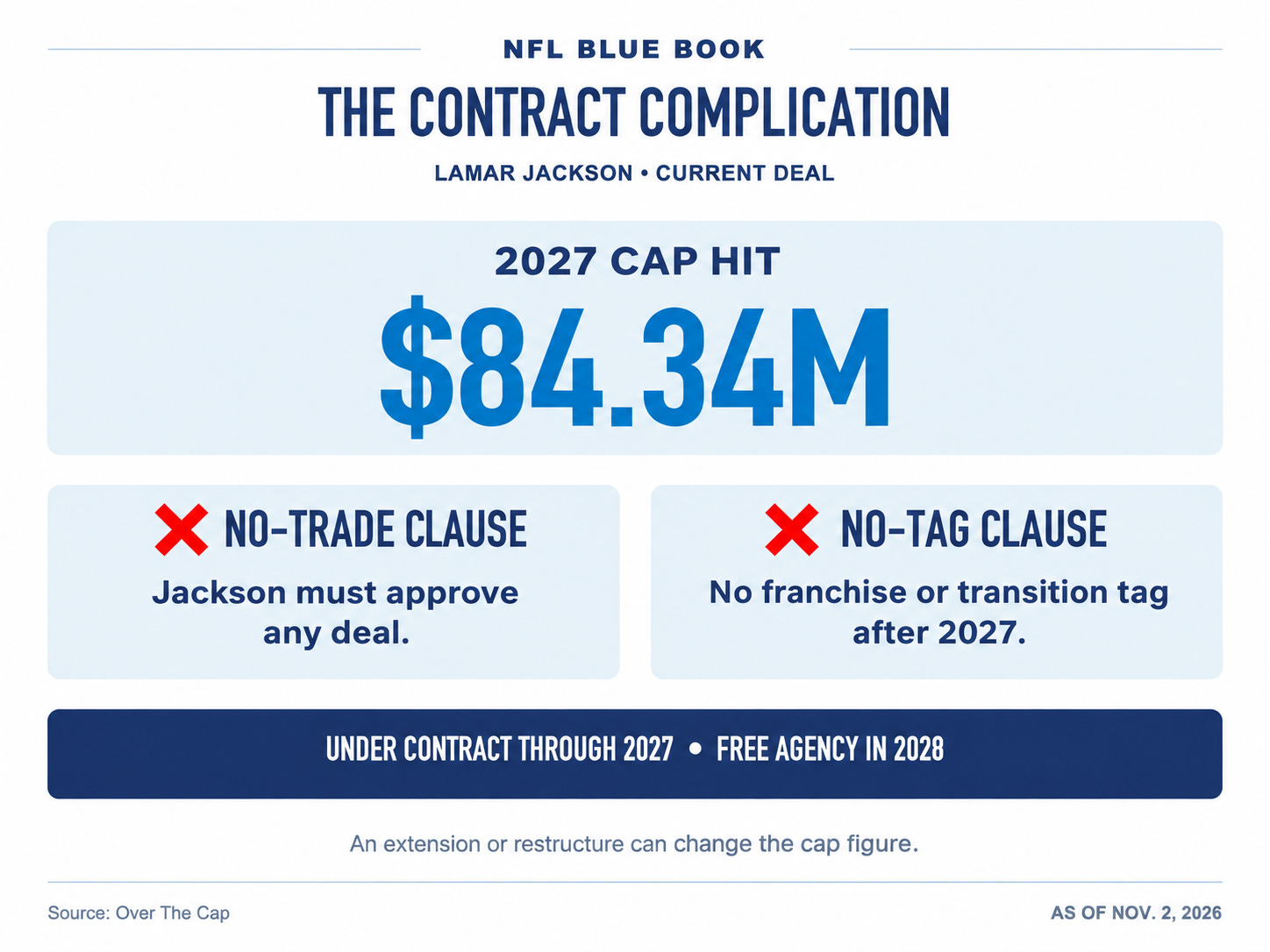
And that’s not all. Jackson also has a no-trade clause that gives him approval over any trade partners, as well as a clause that bars the use of the franchise or transition tags. As I wrote back in September, one veteran NFL agent framed it as arguably the strongest quarterback negotiating position in recent history.
“He can do whatever he wants,” the agent told NFL Blue Book of Jackson in September. “No quarterback has had a better negotiating position in the franchise tag years. Even [the Dallas Cowboys’] Dak [Prescott]. If Lamar wants to be a $65-million [per season] quarterback in Baltimore, he’ll get that. If he wants to play it out to free agency, he could ask for $70 million [per season] and would probably have options.”
Jackson has wielded that control, too. Not only did he hold firm through Bisciotti’s March timetable, but he also hasn’t really declared why. With Jackson lacking an agent, there’s no clear messaging about what’s going through his mind in this process. But the practicality also makes sense. As with his previous extension, the longer he waits, the stronger his position seems to get. That is, until Sunday’s thumb injury pushed some more uncomfortable questions into the spotlight.
A restructure bought time, but did it buy clarity? And with yet another injury that may cut this season short, has it now delivered second thoughts about the future of the franchise in Jackson’s hands?
That latter question should feel familiar, because the Ravens have been in that headspace before. Jackson’s last extension lingered through a franchise tag, a messy trade request and — like now — an avalanche of predictions that the relationship was over. But one month after Jackson announced on social media that he wanted a trade, the Ravens and Jackson agreed to a five-year extension.
That alone should give everyone pause right now. Even with Jackson injured and uncertainty prevailing over the future of the team, it doesn’t guarantee this is all coming to an end.
If this is the end, who are the suitors next offseason?
With Jackson holding the ability to dictate where he’s traded, it’s worth keeping in mind what potential suitors are building elsewhere.
The New York Jets have all the draft capital in the world, but do they have the kind of stable program Jackson would want to commit to? Having trade ammunition is great. But having a coherent plan for success and the roster to execute it is a whole other story.
If not the Jets, there are the Minnesota Vikings, who are undergoing a weekly autopsy on the limitations at their quarterback position and how it’s becoming the anchor weighing down the team’s momentum. Vikings coach Kevin O’Connell has the personality that would connect with Jackson, and there are offensive pieces on the roster that would offer an immediate Super Bowl window. And that’s without even getting to a defensive unit that seems poised to terrorize opponents as long as Brian Flores is the unit’s coordinator.
Then there are the Atlanta Falcons, who are loaded at the skill positions and on a perpetual rollercoaster at quarterback from one season to the next. But it’s hard to forget that Falcons owner Arthur Blank could have pressed for Jackson as a trade option before his last contract extension — and didn’t. When Blank was pressed about the decision, he flagged Jackson’s playing style and health.
“Looking at it objectively, I’d say there’s some concern over how long can he play his style of game,” Blank said in 2023.
With Jackson dealing with multiple injuries this season, it’s fair to wonder if Blank’s concerns wouldn’t still resonate inside Atlanta.
The other obvious destinations? The Arizona Cardinals, who have the quarterback need but don’t stack up as the kind of stable franchise when you consider the decades of futility under the current ownership. The Miami Dolphins are a popular “destination” suggestion, but the roster build for that organization also may be years away from competing. You could even make a case for the Los Angeles Rams — who have a track record of getting aggressive for elite talent — but they also have rookie backup Ty Simpson in the waiting and lack a first round pick in the 2027 NFL draft.
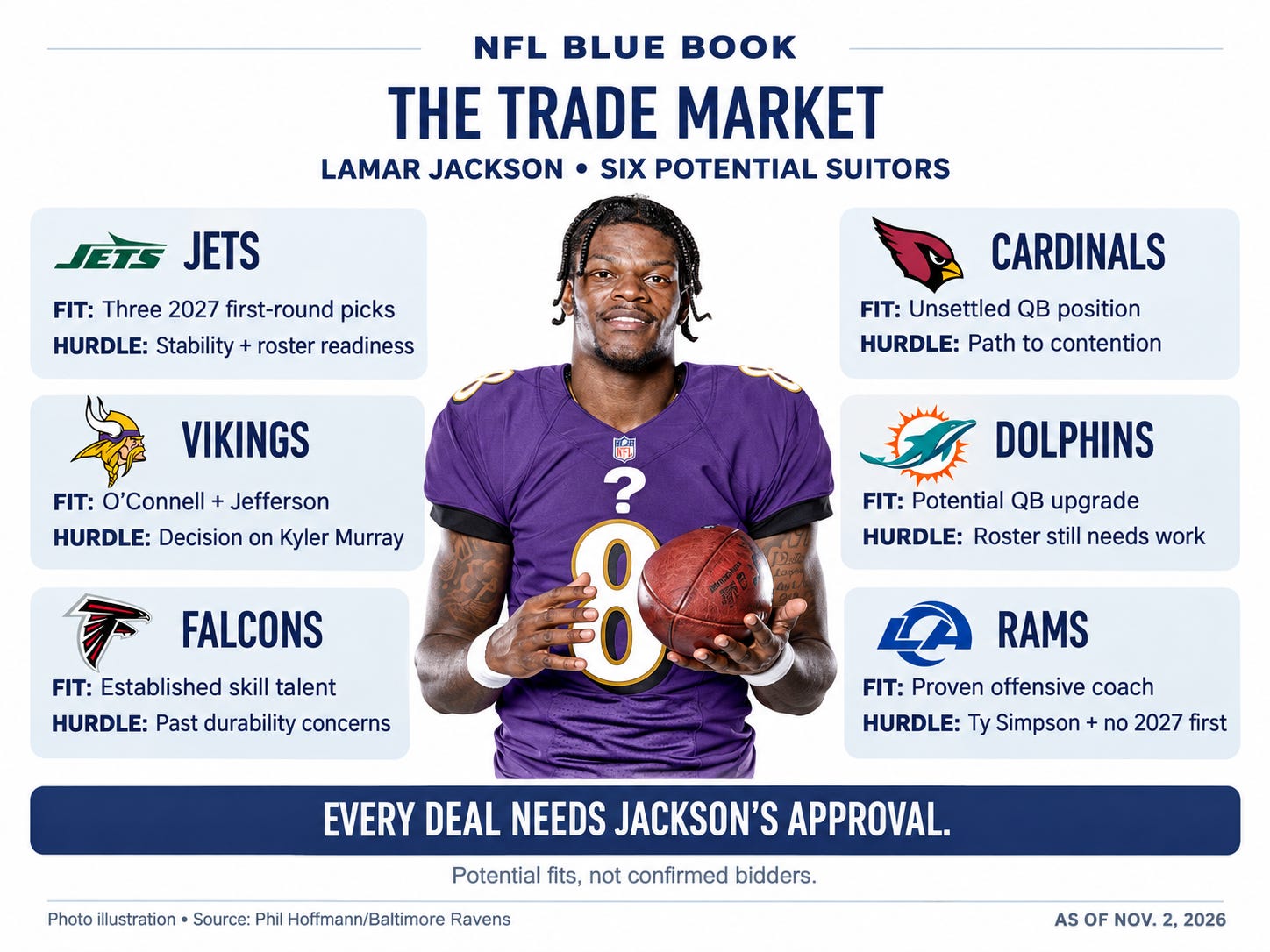
There’s also the factor of price. If you’re the Ravens, Jackson’s talent still represents an asking price of at least two first-round picks and a high-end starter on top. That reality, along with Jackson’s ability to choose his destination, thins out the field extremely quickly.
How would Jackson’s departure impact Baltimore?
This is the part of the conversation orbiting Jackson and the Ravens that does not get attention. We can speculate to the end of time about his days being numbered in Baltimore, but rarely does anyone focus it through the prism of “OK, then what?” For the Ravens, that’s a pretty significant question. It’s one thing to part company with an All-Pro quarterback. It’s another to have the plan in place to survive the ensuing rebuild. And Baltimore would be in line for one if it trades Jackson.
There’s no denying that this is a win-now roster for the Ravens. While there are key young pieces that could survive a rebuild — like safety Kyle Hamilton, wideout Zay Flowers and cornerback Nate Wiggins — there are veterans who would not. Running back Derrick Henry does not have that kind of career runway. Nor do linebacker Roquan Smith and some others.
This is without even addressing the realities of Baltimore’s offense, which is predicated on so many things that Jackson does uniquely well. Not only does he change how defenses account for the running game, but he also shapes how they scheme pressure and coverages. If Baltimore’s offense were a compass, Jackson would be the magnetic needle pointing due north. Take him away and you’ve lost direction.
It’s something that Baltimore would have to grapple with in the wake of a Jackson departure. And there aren’t many options that don’t suggest a total rebuild is right around the corner. DeCosta could pursue an experienced veteran and hope to miraculously find a Sam Darnold-type that is good enough to have the rest of the operation carry him to a title. If not that, he could pursue a bridge starter who holds the fort while another player develops — think: the Las Vegas Raiders with Kirk Cousins and Fernando Mendoza. Or he could meet the rebuild head-on and simply draft a rookie who starts from day one and grows through a total rebuild.
It’s worth noting that the accounting matters here, too. Jackson’s $84.34 million cap charge is an extinction-level event. Any deal that happens prior to June 1 incurs $74.81 million in dead money and a cap savings of only $9.53 million. It’s hard to add any kind of quality veteran quarterback under that weight. Instead, the only logical path is a roster deconstruction and hard reset.
And right there is the rub. That’s what should cast the most doubt on a breakup with Jackson. If you’re DeCosta and you’re staring at the bottom line of the ledger, what would you rather have in 2027? An expensive contender with an All-Pro quarterback who is an injury concern, or an expensive gutted team that is going through salary cap hell and has no quarterback at all?
Even with the latest thumb injury and cycling frustration over extension negotiations, the simple truth for the Ravens is that the best path forward is through a costly Jackson extension. It preserves the roster that is already built for his window. DeCosta knows this. Bisciotti surely does, too.
Go back to those conversations on Monday. One evaluator can look at Jackson and see myopic “organizational blinders,” while another can look at him and see a quarterback that is “still one of the best.” Their disagreement only highlights why a trade seems overdue from one angle and reckless from the next angle. Especially when you consider the finances the move is pressed against.
The Ravens and DeCosta have to live with the consequences that separate the two. And that’s going to guide them. I guarantee it.